
Scatter Plot: The Amount of Time You Work and The Money You Earn
Prediction
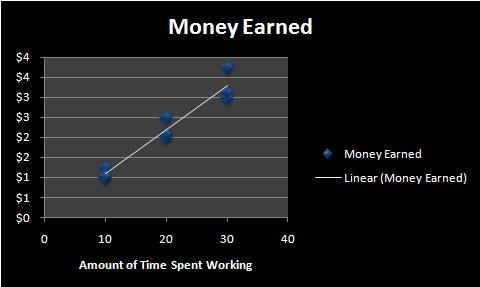
The relationship for my variables will most likely be positive. I can easily tell because it is pretty obvious already. I think the more time you spend working. the more money you earn. I have experienced this question hands on because I have worked for my neighbors and the pay me off the time I spend working. I know how this experiment will turn out.
Conclusion
My project was a complete success. Everything went perfectly to plan. My prediction was completely correct and I was right about how it would be a possitive correlation. As you can clearly see on the graph, there is a clear trend and the line of best fit shows that it is continuous. It is true that when you work longer, you will earn more money.
When I started to get in depth with this project, I was worried that this experiment would prove my hypothesis wrong. I had a good feeling about my prediction, but the results were against me. After readjusting my plan, everything went swimmingly. All I had to do was replace and organize my data and recreate my graph. The little changes made all the difference with the results.


Algebra Algorithms
Problem: 
Algorithm: First, you write your problem. You then subtract one from both sides. You then do that again to get . You then divide both sides by
  . Your final answer is
  . That is your answer.
Way To Check: It is very simple. You first change all of the variables with 1.4. You then multiply 12 by 1.4 to get 16.8. You then add 1.4 to 14 to get 15.4 and add 1.4 again to get 16.8. Your final answer is 16.8 = 16.8.
Problem: 
Algorithm: You first set up your problem properly. You then add a positive 3 to the term that is -3. You then add another 3 to -23 to get  . Next, you divide
  by to get
  . That is your final answer.
Way To Check: You plug in -4 to all of the spaces the variables should be. You then multiply by -4 to get -20. You finally subtract 3 from -20 to get -23. You finally end up with the correct answer which is -23 = -23.
Problem: 
Algorithm: You first set up your problem. You then add a positive 6 to the term which is -6. You do the same to the -8 on the other side to get  . You then multiply
  by
by  . The fours cancel each other out. You finally multiply the other side by four which leaves with
  8.
8.
Way To Check: You substitute  with -8. You then divide -8 by 4 to get -2. On the other side, you multiply -2 by 4 to get -8 again. We know now that the variable is correct because the final answer is
  .
.
Problem:
Algorithm: You first set up the problem properly. You then subtract 1.5 from 1.5 and 1.5 from 2.7. It leaves you with  . You then divide
  by
by  to leave yourself with . You then divide 12 by
  . It is easier to multiply .75 by 12, but it is your choice. It gives you 1.6. The final answer is
Way To Check: You first substitute all of the variables with 1.6. You then multiply by 1.6 to get 1.2. You then add 1.5 to 1.2 to get 2.7 = 2.7. That is your final answer